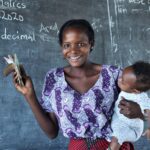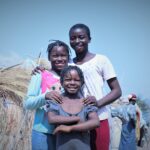
The health centre constructed by ActionAid LRP is serving its purpose- saving lives. After series of unpleasant experiences with traditional birth attendants in the community, Bilikisu summoned the courage to give a fourth trial at childbearing after losing 3 children to poor medical attention as a result of the lack of access to a health care facility. Bilikisu Saidu, 25, is nowa happy mother of 3 surviving children – Halima, 4; Talatu, 3 and Latifa, 3 weeks old.
“I am happy because of the location of this hospital,” Bilikisu said through an interpreter. She could barely raise her emotionally laden voice as she tried to share the experience of losing 3 children because of the inability to access a health centre for delivery. Her 3 surviving children were born in the LRP supported health care centre.
“This health centre is a blessing, it is also timely,” said Charity Ocholi, the government nurse attendant posted to the clinic. Charity was transferred from Igalamela health centre in 2010. She recalled that the community members paid a visit to the Igalamela health centre and requested posting of a nurse to the centre built by ActionAid: “The community people came to our office to request for staff. As soon as they left, my HOD told me to resume duty here. I was very happy because it is home coming for me,” Charity said.
“A lot of pregnant women lose their children because of the distance they travel to access affordable health care service; some use the unapproved traditional birth attendants and some stay at home during the period of pregnancy because of cost” she observed.
The health facility has also attracted the attention of the local government; while ActionAid provided the solar system to power the one room laboratory within the centre; the local government supplied vaccine storage deep freezer.
Charity is self motivated; she surmounts all the attendant challenges of working in a remote community because of the passion to serve her people: “If you don’t fight for your people, your people will be at a loss,” she spoke of her conviction to continue to serve as a nurse in the community.
It was called a Black Monday, a day of rage and protest. Ofoloku community had mobilised 12 members representing men, women and youths of the community. They all wore black T-Shirts as they marched to the Ministry of Education in Lokoja.
Holding up placards which read several pro-education inscriptions, the protesters stood in the sun, refusing to leave without their demands. The State Commissioner for Education was forced to reckon with the protesters, he received their letter of protest and promised to incorporate their demands in the next budget line: “We requested for construction of additional classrooms in addition to the one built by ActionAid, we also requested for toilets in our school in order to stop the open defecation witnessed in the school’s surroundings. Those two demands have been met,” Alhassan Godwin said.
“The Black Monday Campaign signified the death of education in our community; we were mourning the death of our educational system. We know the value of education that is why we want to make sure that government comes to our aid,” said Godwin.
The protesters had valid reasons to mourn the decay of the educational infrastructure in the community; parents were already withdrawing their children from school because of the old structure, which is almost tilting, ready to collapse. The roofs were already thatched and rusty. The mud laced with cemented block structure is as old as the parents and grandparents of the pupils. It called for an emergency, for which the community responded with an organised protest to the Ministry of Education.
Godwin noted that their advocacy is not only towards the government, but they also embarked on sensitizations among themselves as community members. One of such instances was when they discovered the high rate of girls’ school dropout: “We observed very high female school dropout, we knew we had to do something to address it, so we called parents, community leaders, and religious leaders to help us promote the girl child education. It worked; now, there are more girls in secondary school, the transition from primary to secondary school is now high in this community,” Godwin said.
Anase Mommoh’s story could pass for a Nollywood fable. It is a tale of a vulnerable woman who refused to allow her situation of extreme poverty defy her courage to work towards a better life. Anase meandered her way into Osaragada community with nothing but a dusty thick polythene bag containing assortments of her belonging. She knew no one in the community; she had moved from a neighbouring community just to seek refuge in a land she knew no one. No one could take the risk of accommodating a stranger but Sadiku Otaru, 74, the ward head of the community who took the chance.
Otaru is a jolly good man; never struggles to display his contagious loud laughter. He motioned how he easily would have offered to marry Anase who was at the time vulnerable. But no, he recalled how ActionAid through the LRP trained him on gender equality – respecting the rights of male and female: “If not for ActionAid, I would have thought of marrying her (Anase). We were marrying vulnerable women before, but I decided to protect her when she told me her story”. Otaru insists that the LRP poked at their manly ego, but it was for the good of the community: “ActionAid made us to understand the power of women in the community. At first, we (men) were very angry at ActionAid for telling us about gender equality, and they told us not to enslave our wives.” Otaru quickly noted: “As Mary Slessor stopped the killing of twins, ActionAid stopped the maltreatment of women in this community,” he affirms.
Women made little contribution to the community power structure in Osaragada. It was a male-controlled community. That is no longer the case as women now exercise their rights to participate in community meetings and make important decisions like the men.
Anase lived with Otaru’s family with her two children for 5 years, working as a farmer on the piece of land in the community. She practised subsistence farming just to feed her children and add to her host’s barn of food. She narrated how she was selected to attend the LRP training on Agro ecology: “I learnt a lot during the training, I learnt about how to space my crops, how to make manure, we were taught so many things I never knew before.” She quips.
The outcome was dramatic; Anase moved from subsistence farming to commercializing her yield. She sold some and kept some for food. Anase made just enough money to build her own 2-bedroom house on a plot of land donated by the community chief, where she now lives with her son.
The health centre constructed by ActionAid LRP is serving its purpose- saving lives. After series of unpleasant experiences with traditional birth attendants in the community, Bilikisu summoned the courage to give a fourth trial at childbearing after losing 3 children to poor medical attention as a result of the lack of access to a health care facility. Bilikisu Saidu, 25, is nowa happy mother of 3 surviving children – Halima, 4; Talatu, 3 and Latifa, 3 weeks old.
“I am happy because of the location of this hospital,” Bilikisu said through an interpreter. She could barely raise her emotionally laden voice as she tried to share the experience of losing 3 children because of the inability to access a health centre for delivery. Her 3 surviving children were born in the LRP supported health care centre.
“This health centre is a blessing, it is also timely,” said Charity Ocholi, the government nurse attendant posted to the clinic. Charity was transferred from Igalamela health centre in 2010. She recalled that the community members paid a visit to the Igalamela health centre and requested posting of a nurse to the centre built by ActionAid: “The community people came to our office to request for staff. As soon as they left, my HOD told me to resume duty here. I was very happy because it is home coming for me,” Charity said.
“A lot of pregnant women lose their children because of the distance they travel to access affordable health care service; some use the unapproved traditional birth attendants and some stay at home during the period of pregnancy because of cost” she observed.
The health facility has also attracted the attention of the local government; while ActionAid provided the solar system to power the one room laboratory within the centre; the local government supplied vaccine storage deep freezer.
Charity is self motivated; she surmounts all the attendant challenges of working in a remote community because of the passion to serve her people: “If you don’t fight for your people, your people will be at a loss,” she spoke of her conviction to continue to serve as a nurse in the community.
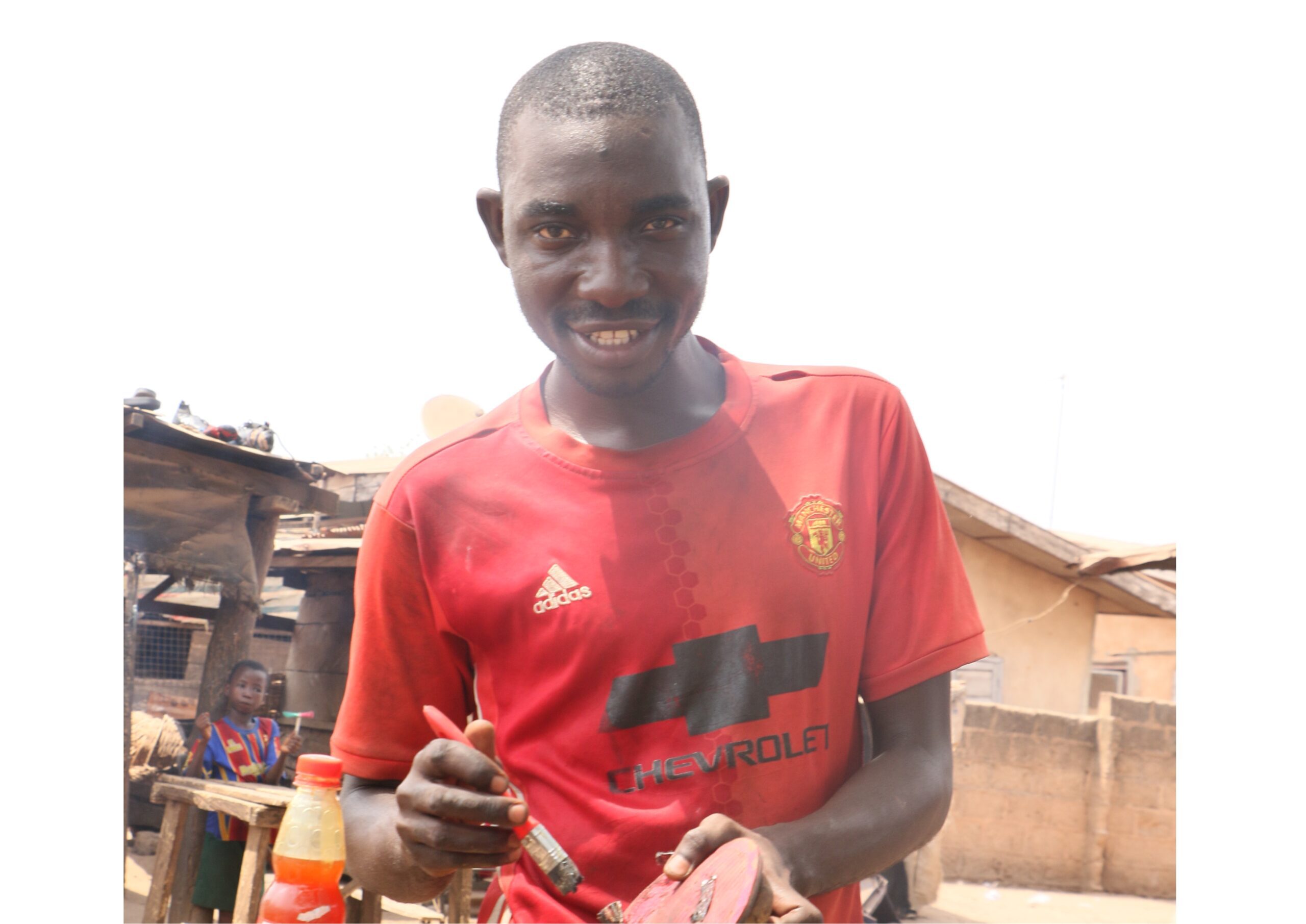
Abdul Fatai made haste to arrange his wears; neatly displayed on the 4 layers wooden shelf are handmade leather sandals, he pulls each out and wipes the edges with a rough dusty piece of cloth. Fatai looks cheerful and satisfied as he paced slowly; holding up his left knee to support his movement, his inability to walk upright does not deter his determination to unleash his potential and work towards his childhood dreams.
Fatai recalled a bullying experience as a child which made him even more determined to become self-reliant: “I could not play with my age mates when I was in school, they will gather and laugh at me, and they will laugh at the way I walk. I am always sad, and I cry about it, that was why I asked my mother why my leg is like this, she said it happened when I was 6 months old” he quips. Fatai’s disability propels his motivation, as he is determined to prove that physical disability is not able to stop a determined mind. “I don’t want to depend on anybody, that is why I am determined to make it in a legitimate way, I know some of my classmates who are into yahoo yahoo (local parlance for internet fraud) but I told myself I will do the right thing to survive,” he said.
Though determined to do the right thing, Fatai had a challenge with funding his dream to be a big-time shoemaker. He admired good shoes and dreamt of building a shoe factory, but the fund to learn the skill was unaffordable: “I wanted to learn how to make shoes in a professional way, it is very expensive so I plan to work and save for it” he noted that while returning home from work he found the team from Kairos and ActionAid making a public announcement for the returnee and potential migrant capacity program, it was his chance and he took it.
Fatai was selected to participate in the capacity development program, he learned shoemaking. “I started making shoes the next day of the training,” he said and in a short while, he built a small shoemaking business and gradually etched toward his childhood dream of owning a shoe factory. “I am very grateful for the chance to learn this shoe making; it has made me believe that I can do anything anybody with two legs can do without depending on other people,” said Fatai.
Beaming with an air-cutting enthusiasm, it is easy to tell that Favour Omofuna is passionate about her fashion business. Favour is a fashion trainer and seamstress like no other; she is not scared of competition or ever running out of business.
Favour and her husband Abel left a lucrative business location in Northern Nigeria, where their fashion business had thrived and their customers swelled for Auchi, a place they had to start from scratch. “I have always wanted to train young girls in fashion, it has always been my dream because I believe you cannot run out of ideas and what to do in fashion, it is very wide because everybody needs clothing, even the madman on the street need clothing, so no matter how many people are into tailoring there is still room for more” Favour insists the fashion business is one of the endless opportunities.
Her fashion outfit, MerPraise Fashion Home was nominated after a rigorous screening process to train selected returnees and potential irregular migrants in fashion designing and cloth making. “When I see young girls aimlessly walking about without doing anything, I use to feel very bad, that was one of the reasons why we relocated to this place so that we can impact the lives of the young people by first making them discover themselves and be sure of what they want from life. That was why I was excited when we were chosen by ActionAid to train the girls, I feel so happy impacting knowledge on young girls” she said, scanning the room filled with an assortment of cloth pieces, and electric sewing machines, she points at Gift Olorunda.
Gift is one of ActionAid’s Migration Project trainees who was the shining light at the MerPraise Fashion Home, Auchi. Gift had lost complete hope in continuing her education when she lost her Daddy at age 6. When she turned 18, she decided to work to support her struggling mother and other siblings.
Gift’s situation is an opportunity for human traffickers who dot around her community; searching for vulnerable prey for irregular migration. “It was a big opportunity for me to be trained by ActionAid in this Fashion Home (MerPraise). I have learned a lot of things that I cannot consider traveling illegally because I have skills that I can make good money from. I promise to put my fashion skills to work, and I will not betray ActionAid” she enthused.
Zainab Imade is the last of 8 children. It was a rowdy home in a small room where everyone struggled for space. Zainab faintly recalled how she and her siblings survived hunger and emotional neglect. So, she thought to herself to redeem the condition of her family by getting an education.
When Zainab completed her secondary education, her parents could not afford her university studies. Her dreams crumbled: “I felt very discouraged and neglected, I felt hindered by money” she muttered in repulsion.
While contemplating on the next step after her inability to proceed to university, she met her secondary school classmate who was also caught up in a similar predicament. They hatched up a plan to travel to Europe: “When I met my secondary schoolmate, she encouraged me to travel out of the country. We thought traveling out was the best option for us than suffering at home”. So they thought.
To avoid being discouraged, Zainab refused to inform her parents or anyone about her planned road trip to Europe, she had been linked to an unseen sponsor who paid her transport fare out of Benin and promised to fund the entire journey. Zainab left without saying goodbye to anyone at home. But as the journey progressed she sensed it was going to be a deadly adventure: “When I was going on the journey, we had so many stops, at a time I could not see my friend and I could not reach my sponsor on the phone. I became confused. Everything they told me was a lie, I cried and prayed I can just return home” she hints at starving for 4 days without food and water to bathe. But she was lucky that it was the end of the journey to the unknown.
In Nigeria, she fell back to hopelessness: “On return to Nigeria, I felt all my plans have ended; I thought life has ended for me” she said.
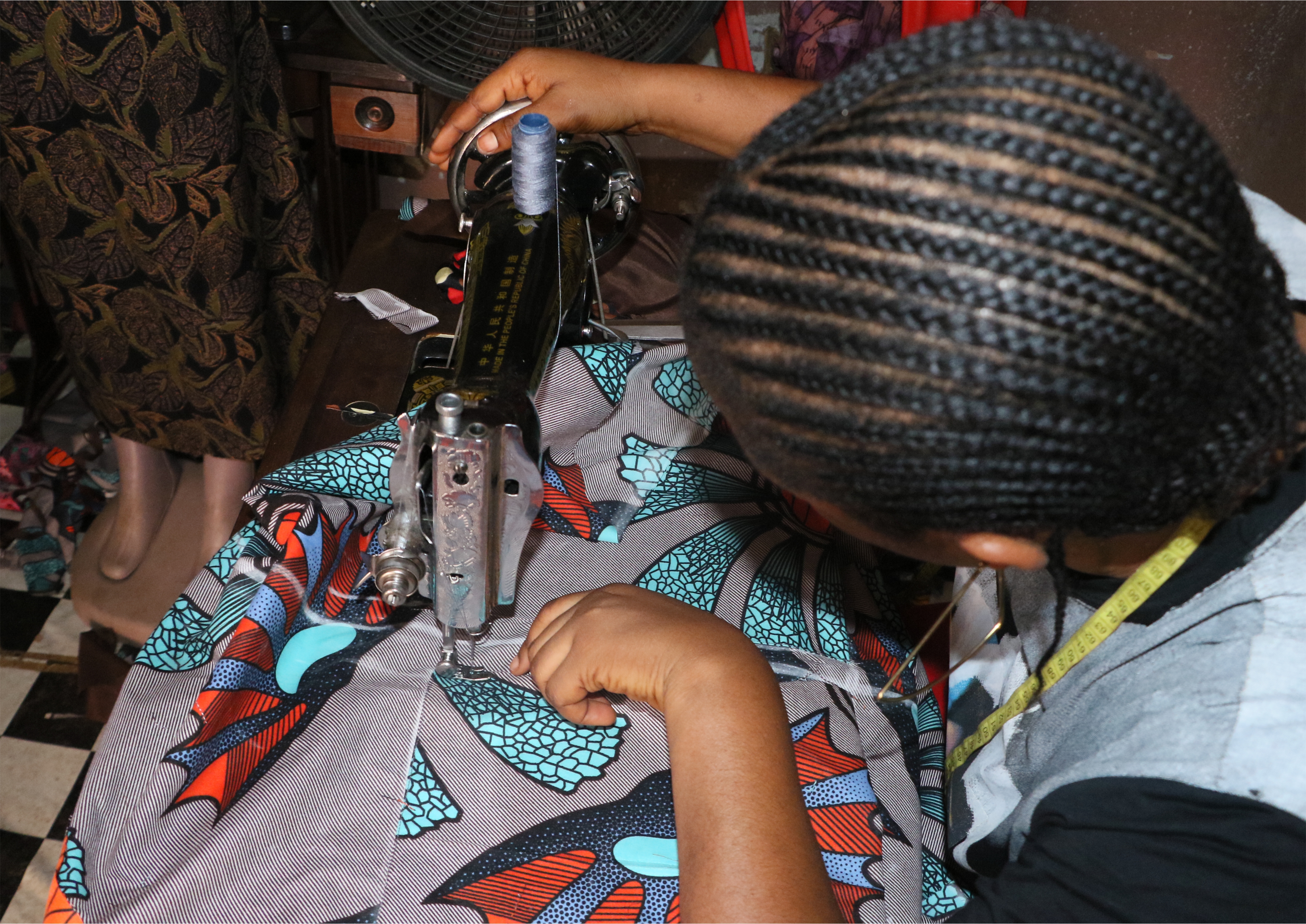
Soon after she returned, she happened on the ActionAid skill training program for returnees and potential migrants. “I decided to learn sewing because I love fashion, I want to say that the training program helped me a lot, it really changed my life” she affirms.
“Now, I can sew very well, I make cloth for people and make money from it to sustain myself and my mother,” she said.
Kudirat Musa has had enough; she thought to herself, it was over. Kudirat is a University graduate but worked for salaries less than that of a laborer. She has had 3 attempts at fairly good job offers but the jobs came with compromising conditions. “Immediately after my NYSC, I got a job, I scaled through the interviews and passed all the tests but the manager called me to his office and told me he liked me and wanted to go out with me. I knew it was a red line and never went back to pick up the appointment letter” Kudirat said.
The sex-for-employment scenario played out again with two more opportunities. At this point, she began to think of quitting the idea of seeking for paid employment for business. Starting a business would be a big hurdle, she had no capital and no one to borrow. “When I couldn’t get a good paid employment, I decided to look for other things to do; I found a secondary school in my area where teachers were needed, so I applied and got the teaching job but the salary was too poor. I was paid Eight Thousand Naira (8,000), and after a month, it was increased to Ten Thousand Naira (10,000) because I was combining teaching 4 subjects in secondary with occasionally attending to the nursery section” nodding in displeasure, Kudirat noted that it was as if her life depended on the job.
She continued working on the meager wage teaching job until an event that will alter her course of life occurred. Her mother died. “It was like the end of the world to me because my mother was like a pillar to me, after her death, I decided to relocate to Auchi to stay with my siblings” she acknowledge that the decision to relocate to Auchi was unintentional.
“One day, I was thinking of many options including traveling abroad, because I was so frustrated, then my brother brought a form and asked me to fill it, I read through and filled the form and after a few weeks I was called to participate in this ActionAid training,” she said.
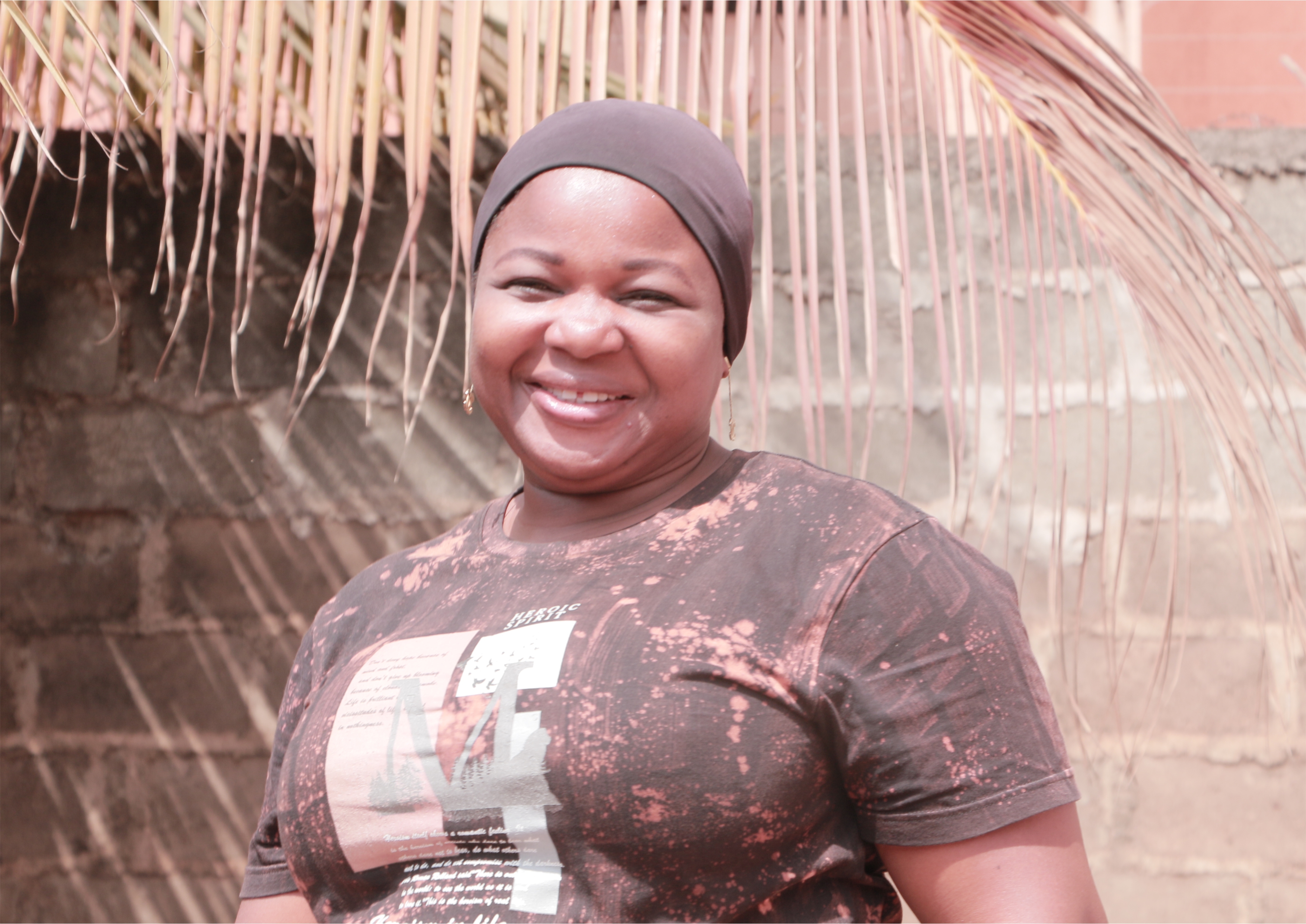
“Let me tell you, if the skill acquisition training did not come at the time it came, I would have traveled out” she affirms. Kudirat tells how their skill in Catering Services transformed her mindset, raised her level of confidence, and made her see the opportunities around her. “I learnt how to bake, I can bake cake very well now, I have baked some cakes that I have sold, and I am now planning big time cake and baking business here in Auchi” no longer interested in illegal migration she insists: “If I must travel now, it will be for vacation” she quips.